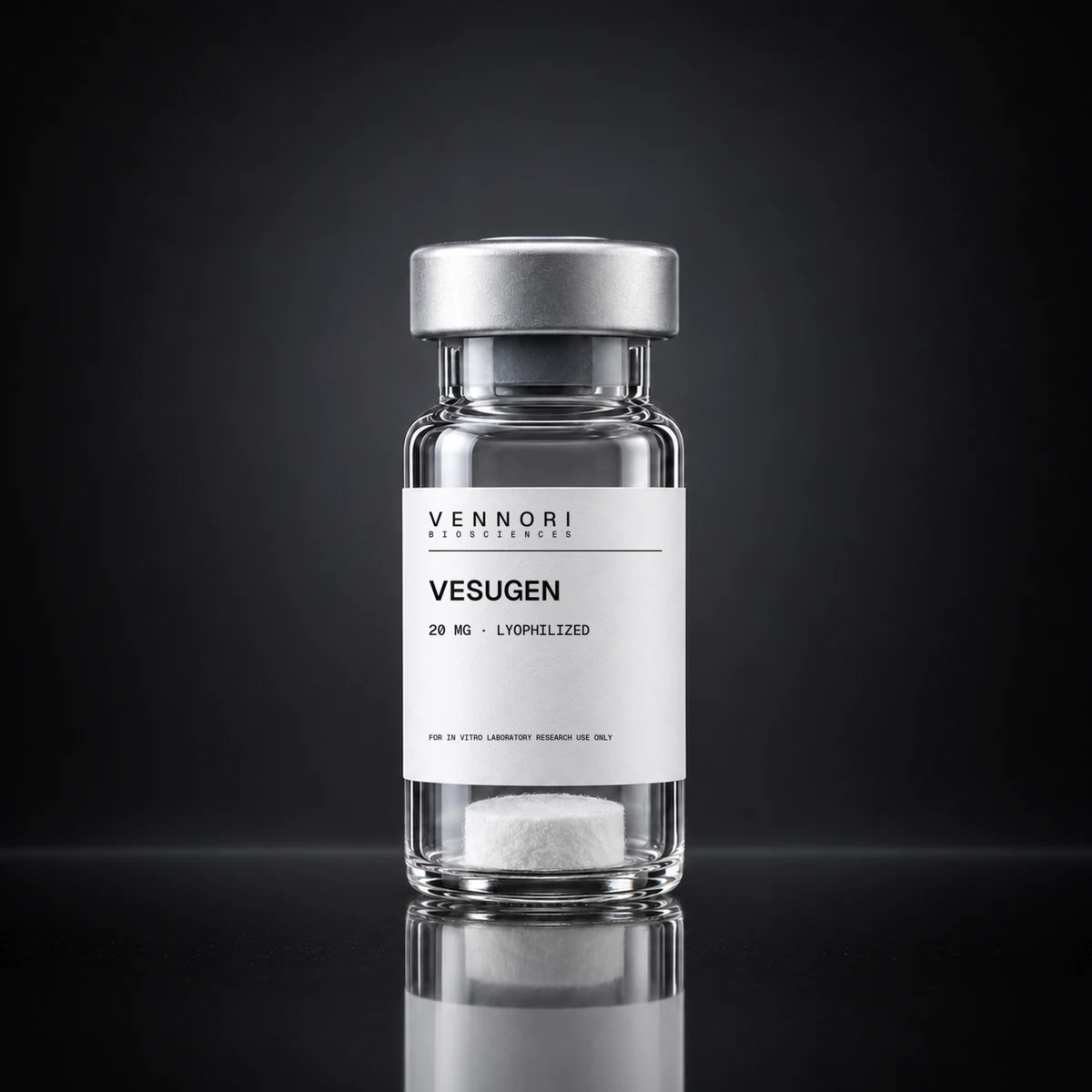
Coming soon
Vesugen
20mg · Single vial · Lyophilized powder
- Dose
- 20mg
- Pack size
- Single vial
- Form
- Lyophilized powder
- Storage
- 2–8°C
In vitro laboratory research use only · Not for human or veterinary use · Batch documented · Third-party tested · Ships from Canada
§ Research
Research · Vesugen
Overview
Vesugen is a synthetic three-residue sequence (Lys-Glu-Asp, designated KED) described by Khavinson's group as a vascular-associated bioregulator. It was developed as a defined synthetic counterpart to vessel-derived low-molecular-weight extracts and is studied in models of endothelial aging, atherosclerosis, and restenosis. More recent work from the same group has extended investigation to neuronal models. Most indexed reports are in vitro studies or reviews authored by the originating research network, and the compound has not been characterized by independent laboratories. Its sequence differs from Cartalax only at the first position, and comparative studies within the series examine whether such single-residue changes alter tissue specificity.
Mechanism of action
The proposed mechanism is epigenetic regulation of endothelial gene expression, with the sequence reported to act on genes encoding markers of endothelial functional activity. In vitro models of atherosclerotic and restenotic endothelium reported normalization of endothelin-1 expression, restoration of connexin expression associated with intercellular communication, and increased sirtuin-1 expression linked to DNA repair. In neuronal models the group reports modulation of p16 and p21 senescence genes, the neuronal differentiation markers nestin and GAP43, and genes including SUMO, APOE, and IGF1. These reports remain largely from a single research network.
Key research findings
- 01
Endothelial cell culture studies modeling atherosclerosis and restenosis characterized changes in endothelin-1, connexin, and sirtuin-1 expression.
- 02
A review from the originating group summarized effects on genes regulating apoptosis, cellular senescence, and neurogenesis, including in an in vitro model of synaptic plasticity loss.
- 03
Studies from the same network in human mesenchymal stem cell and induced neuron cultures examined KED alongside related short sequences for effects on age-related gene expression.
- 04
Primary research is published in Russian-language journals and remains uncharacterized in Western clinical databases.
The information above is derived from published preclinical and clinical research. It is provided for educational purposes only and does not constitute medical advice, diagnosis, or treatment recommendations.