Coming soon
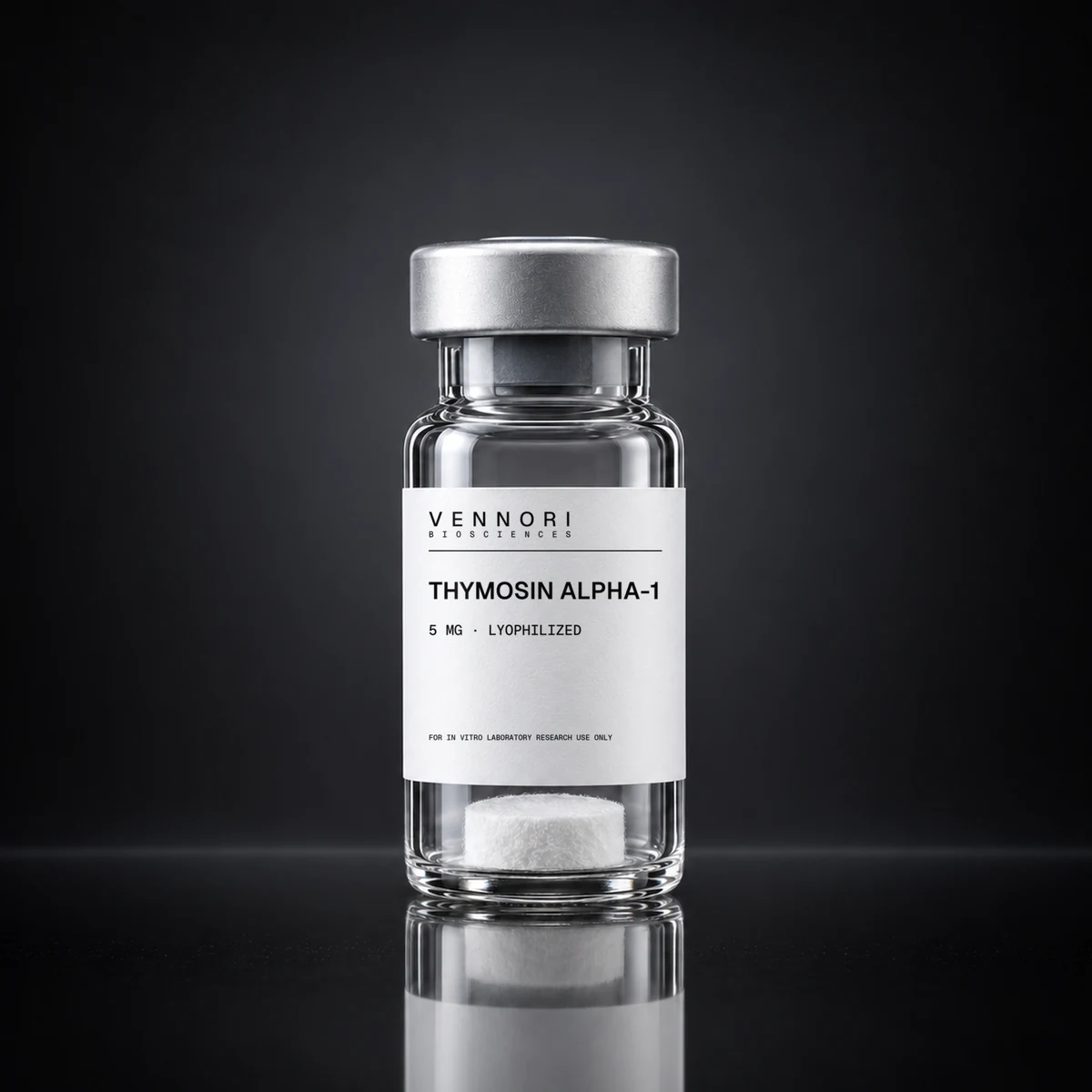
Thymosin Alpha-1
5mg · Single vial · Lyophilized powder
- Dose
- 5mg
- Pack size
- Single vial
- Form
- Lyophilized powder
- Storage
- 2–8°C
In vitro laboratory research use only · Not for human or veterinary use · Batch documented · Third-party tested · Ships from Canada
§ Research
Research · Thymosin Alpha-1
Overview
Thymosin alpha-1 is a 28-residue, N-terminally acetylated sequence originally isolated from calf thymus extract (thymosin fraction 5) and derived in vivo from the precursor prothymosin alpha. A synthetic form, thymalfasin, is approved for clinical use in several jurisdictions outside North America. It was first characterized by Allan Goldstein and colleagues in 1977. It remains a long-standing reference compound in research on thymic function, T-cell maturation, and immune modulation in infectious disease and oncology contexts.
Mechanism of action
Thymosin alpha-1 acts primarily on antigen-presenting cells, engaging Toll-like receptors, notably TLR9 and TLR2, on dendritic cells and signaling through MyD88 to activate NF-kappaB and p38 MAPK pathways. This promotes dendritic cell maturation, increased expression of major histocompatibility complex class I, and production of cytokines such as IL-2, IL-12, and interferon-alpha and gamma. Downstream effects include enhanced T-helper type 1 responses, CD4 and CD8 T-cell maturation, and natural killer cell activity, alongside reported induction of indoleamine 2,3-dioxygenase that contributes to immune tolerance. These dual activating and tolerogenic effects underlie its description as an immune modulator rather than a simple stimulant.
Key research findings
- 01
Clinical trials have characterized thymalfasin in chronic hepatitis B and C, including combination studies with interferon and nucleoside analogs.
- 02
A multicenter randomized trial in severe sepsis (ETASS, 2013) characterized effects on mortality and monocyte HLA-DR expression.
- 03
Oncology studies over several decades have examined thymosin alpha-1 alongside cytotoxic agents and cytokines in melanoma, hepatocellular carcinoma, and non-small cell lung cancer.
- 04
Studies during the COVID-19 pandemic characterized lymphocyte counts and clinical endpoints in hospitalized participants, with heterogeneous results across meta-analyses.
Published references
Thymosin alpha 1: A comprehensive review of the literature
Thymosin alpha 1: past clinical experience and future promise
The information above is derived from published preclinical and clinical research. It is provided for educational purposes only and does not constitute medical advice, diagnosis, or treatment recommendations.