Certivos verified
Analycor Laboratories
Independent Analysis
- Purity
- 99.2%
- Method
- HPLC + LC-MS
- Test date
- 2026-06-05
AKU8V5QGQ3GP→ View certificate
This site supplies research compounds and laboratory materials for in vitro research only. Not for human or veterinary use.
I confirm I am 21 years of age or older and that any purchase is for laboratory research use only.
UP TO 30% OFF Retatrutide · Semaglutide · Tirzepatide — Limited TimeShop now
In stock
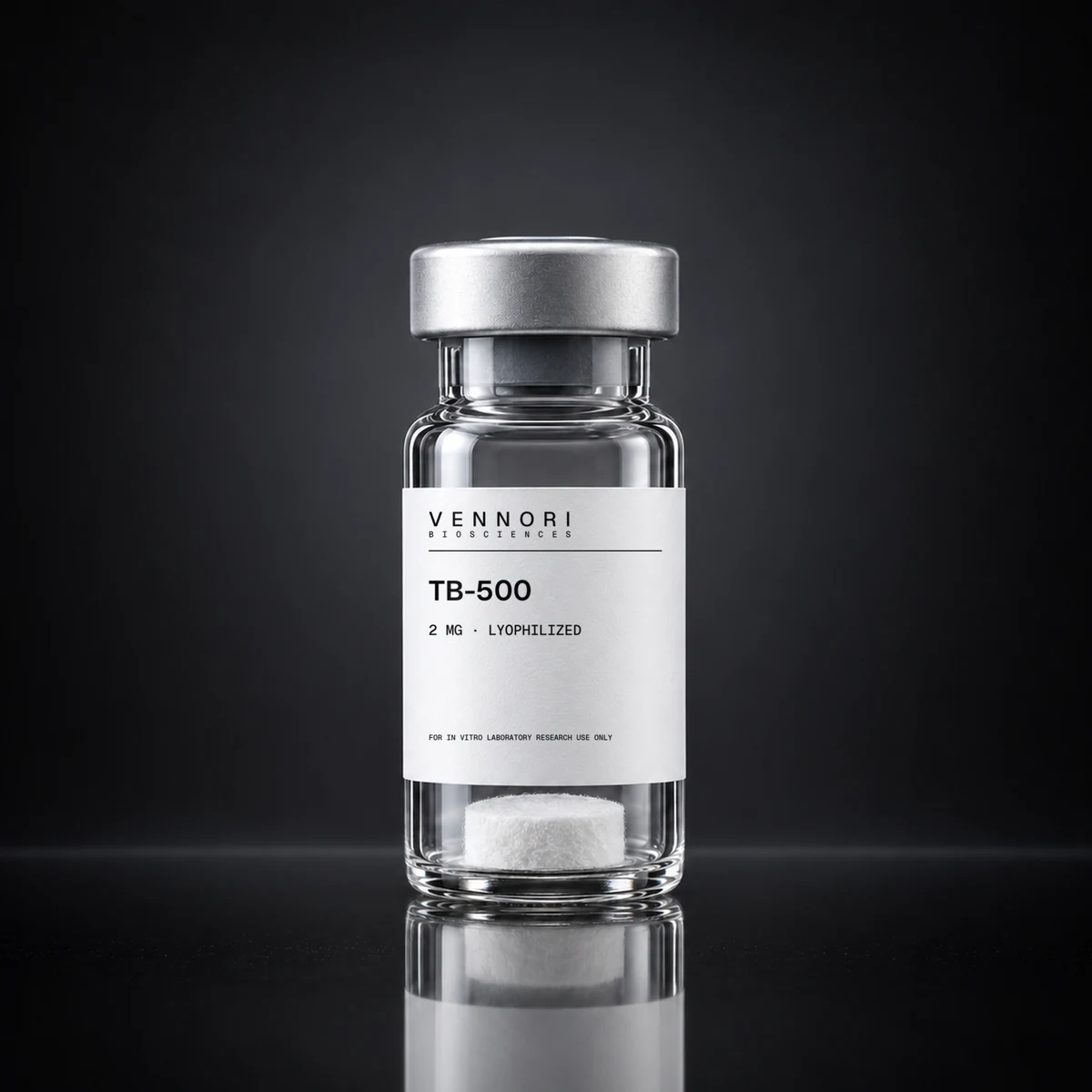
2mg · Single vial · Lyophilized powder
Order
No crypto required. Pay with Visa, Mastercard, Amex, Apple Pay, Google Pay, or Interac.






In vitro laboratory research use only · Not for human or veterinary use · Batch documented · Third-party tested · Ships from Canada
§ Verification — Batch 169265TB
Analycor Laboratories
Independent Analysis
Certificates are issued and hosted by Certivos.
§ Research
TB-500 designates a synthetic, N-terminally acetylated seven-residue sequence, Ac-Leu-Lys-Lys-Thr-Glu-Thr-Gln (Ac-LKKTETQ), corresponding to residues 17-23 of thymosin beta-4, a 43-residue actin-sequestering protein abundant in platelets and most nucleated cells. The name originated in veterinary products, and analytical work has confirmed Ac-LKKTETQ as their principal constituent. The term is sometimes applied loosely to full-length thymosin beta-4, so identity should be confirmed analytically by mass spectrometry. Most mechanistic and clinical literature describes the full-length protein rather than the fragment, a distinction relevant when interpreting data.
The 17-23 region lies within the central actin-binding motif of thymosin beta-4, which binds monomeric G-actin in a 1:1 complex and regulates the cellular pool available for filament assembly, influencing cell migration. Full-length thymosin beta-4 also reportedly engages integrin-linked kinase and Akt signaling and is the precursor of Ac-SDKP, an N-terminal four-residue fragment released by protease cleavage with anti-fibrotic activity. Because Ac-SDKP derives from residues 1-4, it cannot be generated from TB-500; whether the isolated fragment reproduces the full protein's signaling activity has not been established.
Full-length thymosin beta-4 has been characterized in preclinical cardiac, corneal, dermal, and renal injury models and in early-phase clinical studies of ophthalmic formulations.
Doping-control laboratories have synthesized Ac-LKKTETQ and developed liquid chromatography-mass spectrometry methods to detect it and its metabolites in equine and human matrices.
In vitro and rat studies have characterized the fragment's metabolic products, and a 2026 rat Achilles tendon study reported histological and biomechanical endpoints.
Controlled human data specific to the fragment are absent, and it is listed on the World Anti-Doping Agency prohibited list.
Doping control analysis of TB-500, a synthetic version of an active region of thymosin β₄, in equine urine and plasma by liquid chromatography-mass spectrometry
Synthesis and characterization of the N-terminal acetylated 17-23 fragment of thymosin beta 4 identified in TB-500, a product suspected to possess doping potential
The information above is derived from published preclinical and clinical research. It is provided for educational purposes only and does not constitute medical advice, diagnosis, or treatment recommendations.