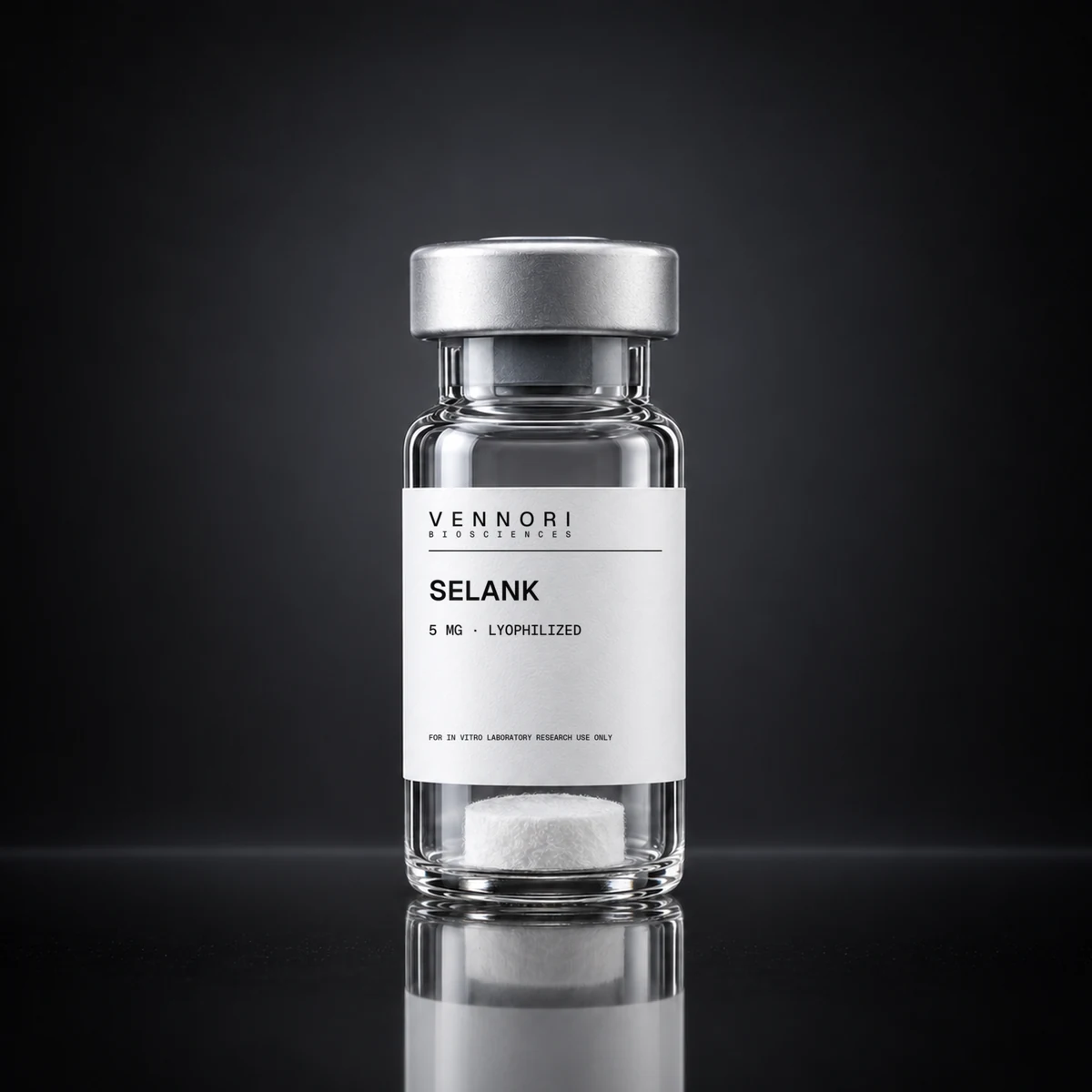
Coming soon
Selank
5mg · Single vial · Lyophilized powder
- Dose
- 5mg
- Pack size
- Single vial
- Form
- Lyophilized powder
- Storage
- 2–8°C
In vitro laboratory research use only · Not for human or veterinary use · Batch documented · Third-party tested · Ships from Canada
§ Research
Research · Selank
Overview
Selank is a synthetic seven-residue analog of tuftsin, an immunomodulatory tetramer derived from the Fc region of immunoglobulin G. Its sequence, Thr-Lys-Pro-Arg-Pro-Gly-Pro, extends the native Thr-Lys-Pro-Arg motif with a C-terminal Pro-Gly-Pro glyproline segment that increases metabolic stability. Developed at the Institute of Molecular Genetics of the Russian Academy of Sciences, it is studied as a reference compound in anxiolytic, stress-response, and immunomodulation research. It shares the glyproline stabilizing strategy with Semax, and the two compounds are frequently compared in Russian neuropharmacology literature. Studies have examined its behavioral, gene-expression, and immunological profiles in rodent models and cultured neuronal cells.
Mechanism of action
A single high-affinity receptor has not been identified, and the proposed mechanisms are multiple. The compound has been reported to inhibit enkephalin-degrading enzymes in human plasma, prolonging the half-life of endogenous enkephalins. Gene-expression studies report modulation of transcripts involved in GABAergic neurotransmission, and allosteric interaction with GABA-A receptors has been proposed. Further reported effects include altered expression of inflammation-related genes and cytokines, consistent with the immunomodulatory activity of the parent tuftsin sequence, as well as effects on monoamine metabolism in rodent brain. Its metabolic fragments, including shorter glyproline-containing sequences, have been proposed to contribute independently to the observed activity profile, complicating attribution to the intact seven-residue molecule.
Key research findings
- 01
In vitro assays demonstrate inhibition of enkephalin-degrading enzyme activity in human serum, proposed as a contributor to its behavioral profile.
- 02
Rodent and cell-culture studies characterize changes in expression of genes involved in GABAergic neurotransmission following exposure.
- 03
Preclinical stress models characterize behavioral endpoints in anxiety-related paradigms and associated changes in cytokine levels.
- 04
Primary research is published in Russian-language journals and remains uncharacterized in Western clinical databases.
Published references
The inhibitory effect of Selank on enkephalin-degrading enzymes as a possible mechanism of its anxiolytic activity
Selank Administration Affects the Expression of Some Genes Involved in GABAergic Neurotransmission
The information above is derived from published preclinical and clinical research. It is provided for educational purposes only and does not constitute medical advice, diagnosis, or treatment recommendations.