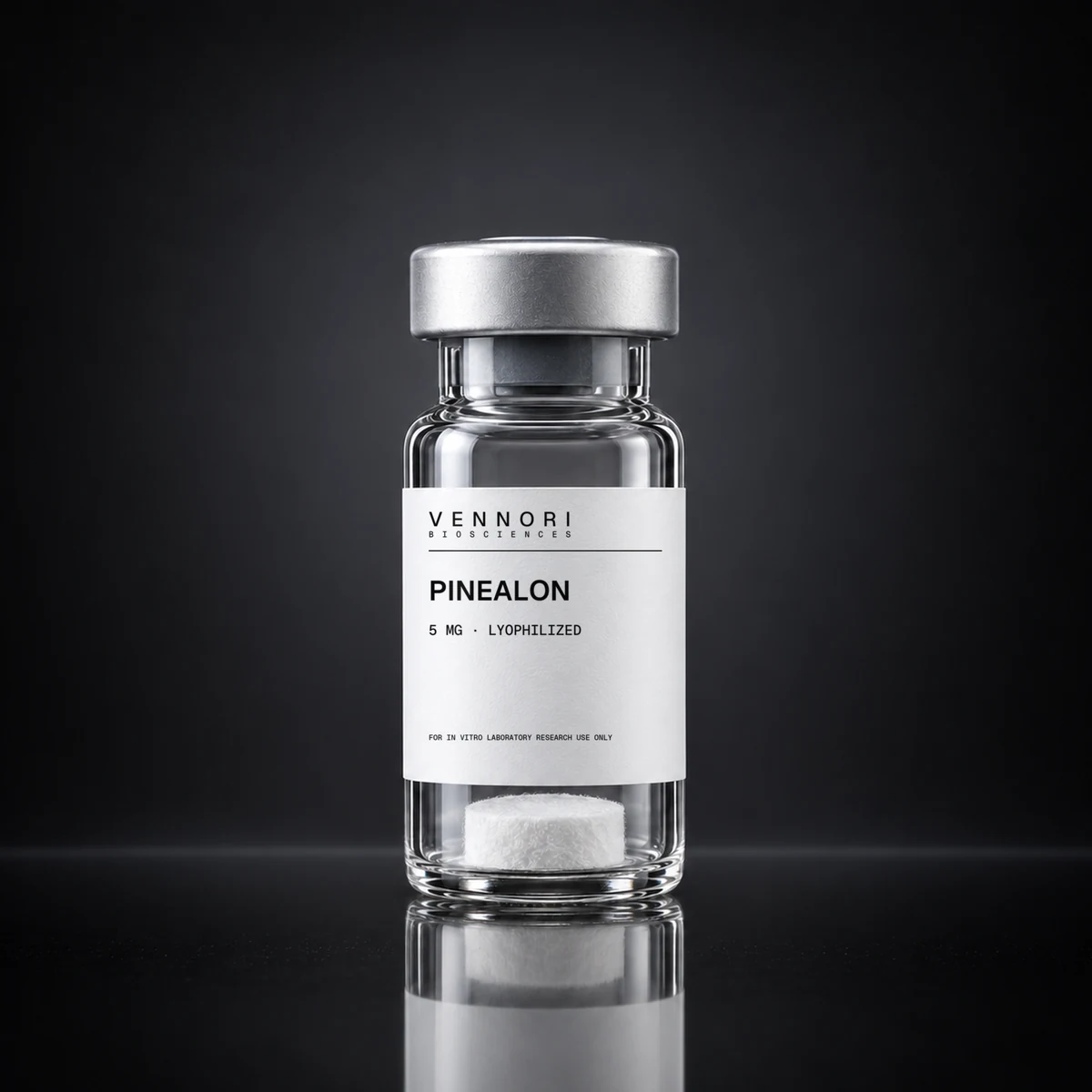
Coming soon
Pinealon
5mg · Single vial · Lyophilized powder
- Dose
- 5mg
- Pack size
- Single vial
- Form
- Lyophilized powder
- Storage
- 2–8°C
In vitro laboratory research use only · Not for human or veterinary use · Batch documented · Third-party tested · Ships from Canada
§ Research
Research · Pinealon
Overview
Pinealon is a synthetic three-residue sequence (Glu-Asp-Arg) described by Khavinson's group as a short bioregulator associated with central nervous system tissue. It originated from fractionation work on brain-derived extracts and is studied as a research compound in models of oxidative stress, hypoxia, and neuronal aging. Its small size and charged residues have made it a subject of interest in studies of direct short-sequence interaction with nucleic acids. Most published work comes from the St. Petersburg Institute of Bioregulation and Gerontology and collaborating Russian laboratories, with a smaller number of English-language reports in international journals.
Mechanism of action
The proposed mechanism centers on nuclear entry and direct interaction with DNA, with biophysical studies examining how mono- and divalent ions influence Glu-Asp-Arg binding to the double helix. The originating group reports that this interaction modulates expression of genes involved in neuronal differentiation, apoptosis, and serotonin signaling. Additional reported activities include suppression of reactive oxygen species accumulation and reduced caspase-3 activity in neural tissue, consistent with a proposed antioxidant and anti-apoptotic profile.
Key research findings
- 01
A rat model of prenatal hyperhomocysteinemia reported that maternal exposure was associated with improved spatial orientation and learning in offspring and with lower reactive oxygen species accumulation in isolated cerebellar neurons.
- 02
Studies in aged rats under acute hypobaric hypoxia and mild hypothermia characterized changes in behavior, free radical processes, caspase-3 activity, and brain monoamine content.
- 03
Cell culture work from the originating group reported altered expression of signaling molecules, including serotonin, in cortical and pineal cell cultures.
- 04
Primary research is published in Russian-language journals and remains uncharacterized in Western clinical databases.
Published references
Pinealon protects the rat offspring from prenatal hyperhomocysteinemia
[Pinealon and Cortexin influence on behavior and neurochemical processes in 18-month aged rats within hypoxia and hypothermia]
The information above is derived from published preclinical and clinical research. It is provided for educational purposes only and does not constitute medical advice, diagnosis, or treatment recommendations.