Coming soon
Oxytocin
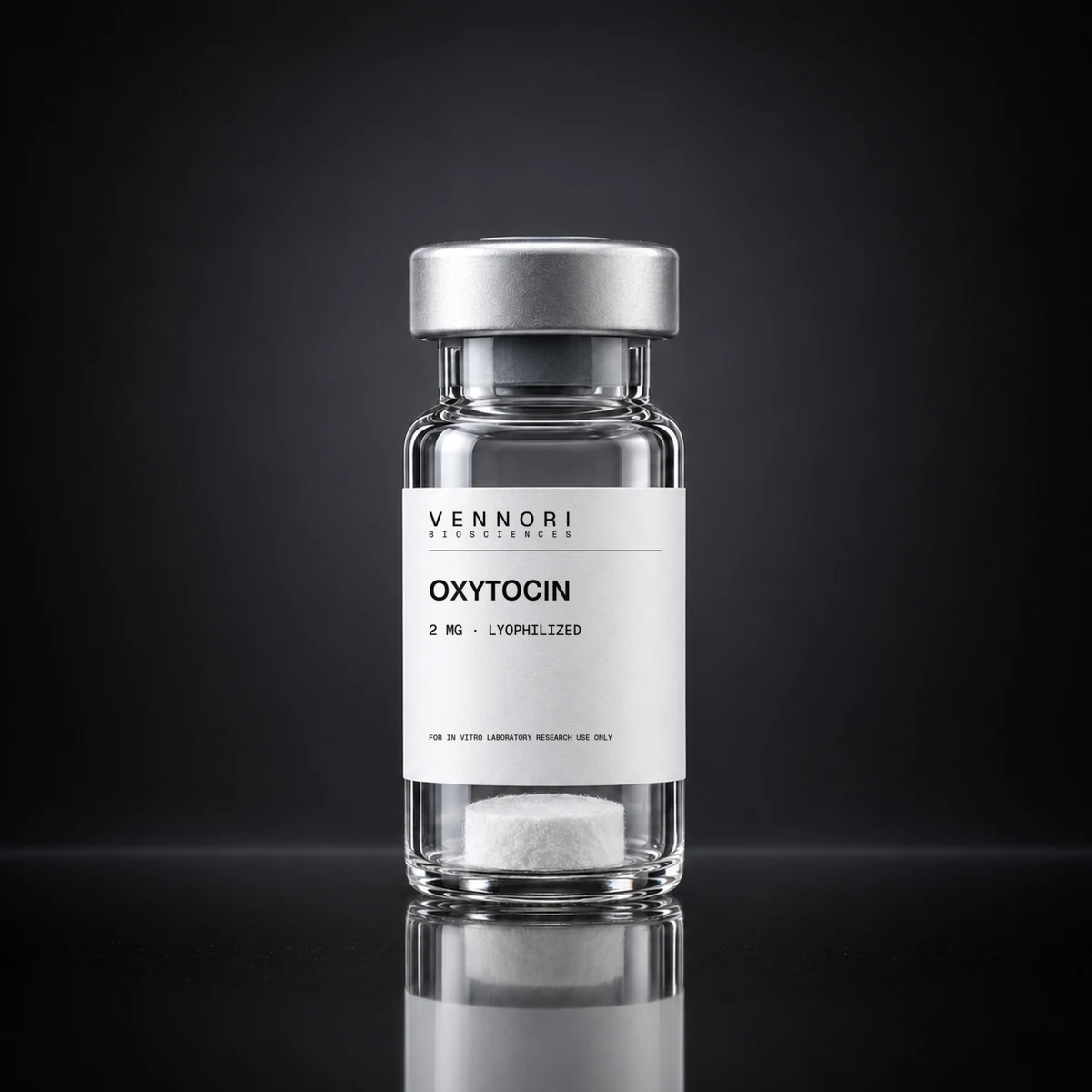
2mg · Single vial · Lyophilized powder
- Dose
- 2mg
- Pack size
- Single vial
- Form
- Lyophilized powder
- Storage
- 2–8°C
In vitro laboratory research use only · Not for human or veterinary use · Batch documented · Third-party tested · Ships from Canada
§ Research
Research · Oxytocin
Overview
Oxytocin is a nine-residue neurohypophysial hormone synthesized primarily in magnocellular neurons of the hypothalamic paraventricular and supraoptic nuclei and released into the circulation from the posterior pituitary. Its structure features a six-residue ring formed by a disulfide bridge between cysteines at positions 1 and 6, with a three-residue tail ending in a C-terminal glycinamide. It differs from vasopressin at only two positions. Oxytocin also acts centrally as a neuromodulator and is a standard reference ligand in neuroendocrine and social-behavior research, and its synthetic form is approved for clinical use in several jurisdictions.
Mechanism of action
Binds the oxytocin receptor (OXTR), a class A G-protein-coupled receptor coupled predominantly to Gq/11. Receptor activation stimulates phospholipase C-beta, generating inositol trisphosphate and diacylglycerol, which mobilize intracellular calcium and activate protein kinase C. In smooth muscle this drives calcium-calmodulin-dependent myosin light chain phosphorylation and contraction; in myoepithelial cells it mediates milk ejection. Central OXTR expression in the amygdala, nucleus accumbens, and other regions underlies its neuromodulatory effects. At higher concentrations oxytocin also shows activity at vasopressin receptors, and receptor signaling is modulated by membrane cholesterol and magnesium.
Key research findings
- 01
Established as a reference agonist in OXTR binding and signaling studies, with receptor structure and regulation characterized across tissues and species.
- 02
Preclinical rodent studies characterize effects on maternal behavior, social recognition, and pair bonding, with circuit-level studies identifying oxytocin-dependent plasticity in cortical and limbic regions.
- 03
Clinical pharmacology studies document a short plasma half-life of several minutes, reflecting rapid enzymatic degradation.
- 04
Investigational human studies have characterized intranasal oxytocin effects on social cognition and stress-related endpoints, with heterogeneous results across trials.
Published references
The oxytocin receptor system: structure, function, and regulation
Oxytocin, Neural Plasticity, and Social Behavior
The information above is derived from published preclinical and clinical research. It is provided for educational purposes only and does not constitute medical advice, diagnosis, or treatment recommendations.