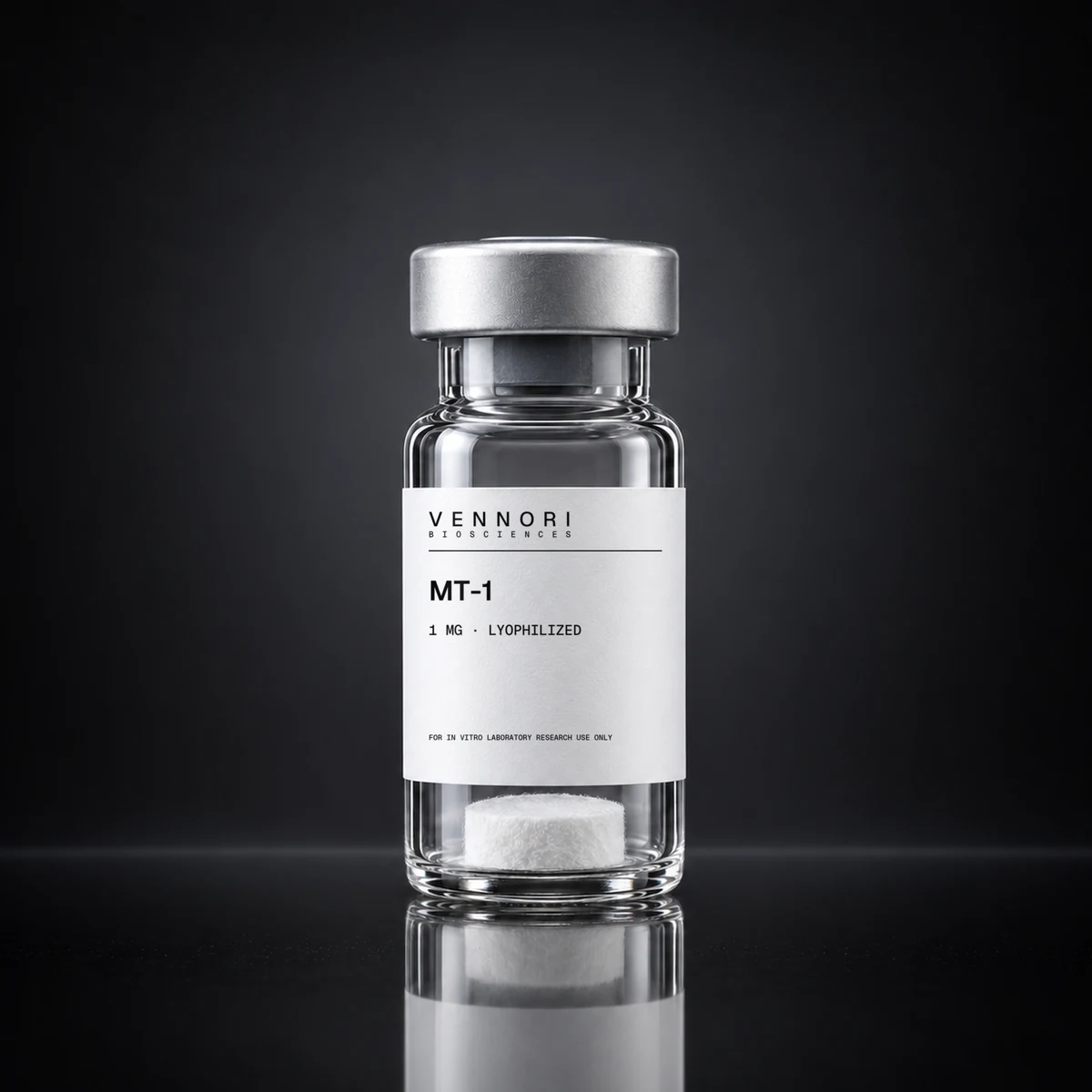
Coming soon
MT-1
1mg · Single vial · Lyophilized powder
- Dose
- 1mg
- Pack size
- Single vial
- Form
- Lyophilized powder
- Storage
- 2–8°C
In vitro laboratory research use only · Not for human or veterinary use · Batch documented · Third-party tested · Ships from Canada
§ Research
Research · MT-1
Overview
MT-1 (Melanotan-1, afamelanotide) is a synthetic linear analog of alpha-melanocyte-stimulating hormone, [Nle4, D-Phe7]-alpha-MSH. Substitution of norleucine for methionine at position 4 and D-phenylalanine for L-phenylalanine at position 7 increases potency and resistance to enzymatic degradation relative to the native hormone. It was developed at the University of Arizona and is approved as afamelanotide in several jurisdictions. It is studied as a reference MC1R agonist in pigmentation and photobiology research. Its development grew out of structure-activity studies of the native thirteen-residue hormone, which has a very short circulating half-life.
Mechanism of action
Acts primarily as an agonist at the melanocortin 1 receptor (MC1R), a Gs-coupled receptor expressed on melanocytes, with lower activity at other melanocortin subtypes. Receptor activation raises intracellular cAMP, inducing microphthalmia-associated transcription factor and tyrosinase and shifting melanogenesis toward eumelanin. Eumelanin provides photoprotection through light absorption and free-radical scavenging. MC1R signaling is also reported to enhance DNA repair and antioxidant responses in UV-exposed skin cells. Unlike Melanotan-2, the linear structure confers greater MC1R selectivity and minimal central nervous system activity. The compound also binds MC3R, MC4R, and MC5R with lower potency, and reported anti-inflammatory effects in skin models are attributed to MC1R signaling in immune and endothelial cells. Its circulating half-life is short, and the native hormone it mimics is rapidly cleaved in plasma.
Key research findings
- 01
Phase 3 randomized trials in erythropoietic protoporphyria characterized duration of pain-free sunlight exposure and quality-of-life endpoints.
- 02
Clinical pharmacokinetic studies characterize plasma exposure and increases in skin melanin density measured by spectrophotometry.
- 03
In vitro assays demonstrate MC1R-dependent eumelanin synthesis and reduced UV-induced DNA damage in melanocytes.
- 04
Investigational studies have characterized pigmentation endpoints in vitiligo and other photodermatoses.
Published references
Afamelanotide for Erythropoietic Protoporphyria
Afamelanotide: A Review in Erythropoietic Protoporphyria
The information above is derived from published preclinical and clinical research. It is provided for educational purposes only and does not constitute medical advice, diagnosis, or treatment recommendations.