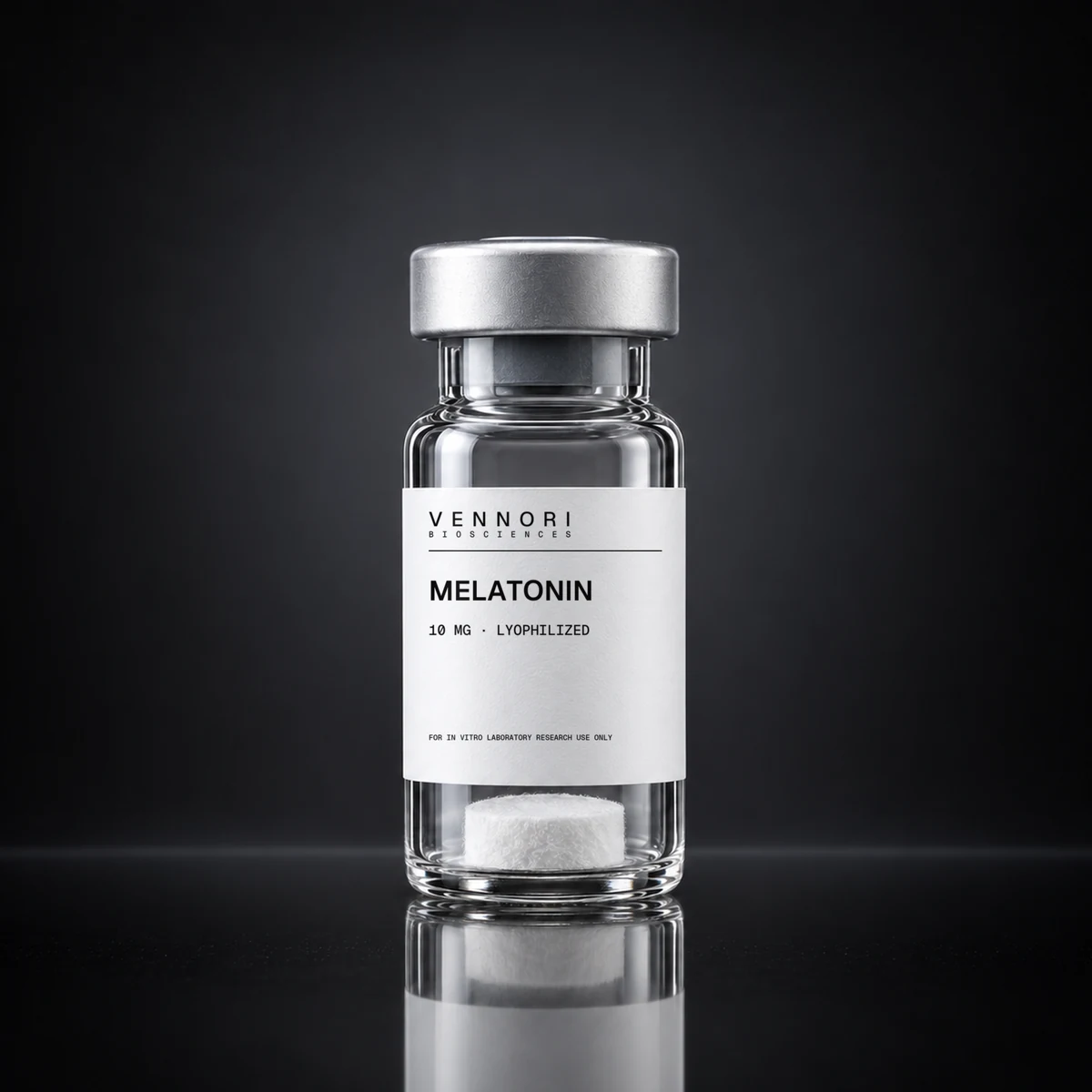
Coming soon
Melatonin
10mg · Single vial · Lyophilized powder
Price on release
- Dose
- 10mg
- Pack size
- Single vial
- Form
- Lyophilized powder
- Storage
- 2–8°C
In vitro laboratory research use only · Not for human or veterinary use · Batch documented · Third-party tested · Ships from Canada
§ Research
Research · Melatonin
Overview
Melatonin (N-acetyl-5-methoxytryptamine) is an indoleamine synthesized from tryptophan via serotonin, primarily by the pineal gland under circadian control by the suprachiasmatic nucleus. Secretion rises during darkness and is suppressed by light, making it the principal hormonal signal of circadian phase. It is also produced in the retina, gut, and other tissues, and is found widely across plants and microorganisms. It is a reference compound in chronobiology, sleep, and oxidative-stress research. Its small size and amphiphilic character allow it to cross cell membranes and the blood-brain barrier readily, and it is approved as a prescription product in several jurisdictions.
Mechanism of action
Activates two high-affinity G-protein-coupled receptors, MT1 (MTNR1A) and MT2 (MTNR1B), which couple predominantly to Gi proteins to inhibit adenylyl cyclase and reduce cAMP. MT1 activation in the suprachiasmatic nucleus suppresses neuronal firing, while MT2 activation mediates phase-shifting of circadian rhythms. A lower-affinity binding site, quinone reductase 2 (formerly MT3), has also been described. Independently of receptors, the molecule and its metabolites act as direct free-radical scavengers and upregulate antioxidant enzymes. Hepatic CYP1A2 hydroxylation is the principal clearance pathway. Melatonin receptors are also expressed in retina, vasculature, immune cells, and peripheral metabolic tissues, which accounts for the broad range of endpoints investigated in preclinical models.
Key research findings
- 01
Receptor pharmacology and structural studies characterize MT1 and MT2 binding, signaling, and selectivity, supporting development of synthetic melatonergic agonists.
- 02
In vitro assays demonstrate direct scavenging of hydroxyl and other reactive species and induction of antioxidant enzyme expression.
- 03
Rodent and human chronobiology studies characterize phase-shifting effects on circadian rhythms dependent on timing of exposure.
- 04
Clinical pharmacokinetic studies document a short elimination half-life with substantial first-pass hepatic metabolism.
Published references
MT1 and MT2 Melatonin Receptors: A Therapeutic Perspective
Melatonin as an antioxidant: under promises but over delivers
The information above is derived from published preclinical and clinical research. It is provided for educational purposes only and does not constitute medical advice, diagnosis, or treatment recommendations.