Coming soon
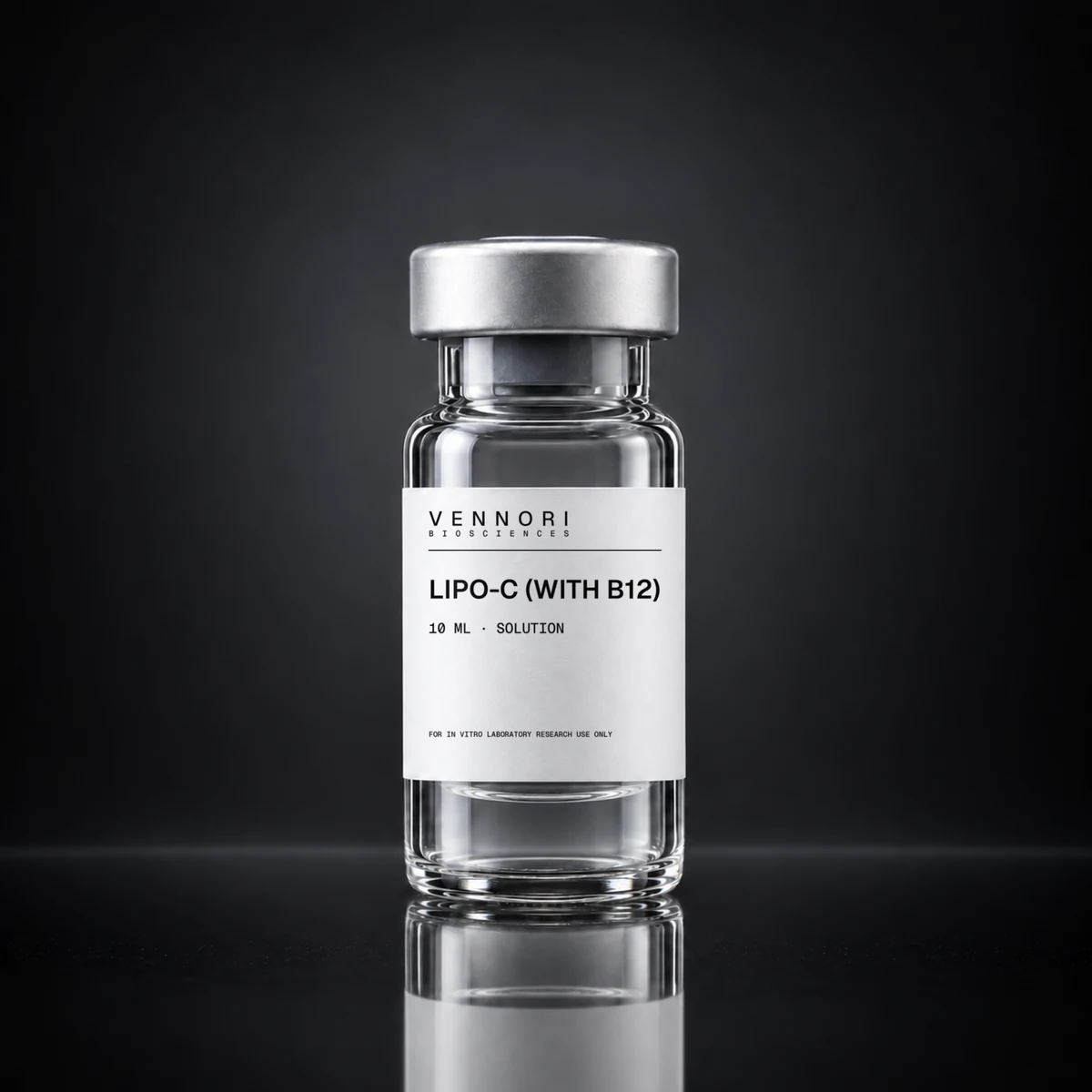
Lipo-C (With B12)
10ml · Single vial · Solution
- Dose
- 10ml
- Pack size
- Single vial
- Form
- Solution
- Storage
- —
In vitro laboratory research use only · Not for human or veterinary use · Batch documented · Third-party tested · Ships from Canada
§ Research
Research · Lipo-C (With B12)
Overview
Lipo-C (With B12) is a lipotropic formulation combining methionine, inositol, choline, and L-carnitine with cyanocobalamin. Methionine is an essential sulfur amino acid and methyl donor precursor; inositol is a cyclic polyol that forms the head group of phosphoinositide lipids; choline is a precursor of phosphatidylcholine and acetylcholine; L-carnitine is a fatty acid carrier; and cyanocobalamin is a stable synthetic form of vitamin B12. The term lipotropic historically refers to compounds characterized in hepatic lipid export research. Each component has an independent biochemical literature, which forms the basis for describing the formulation.
Mechanism of action
Each component acts through a distinct pathway. Methionine is converted to S-adenosylmethionine, the principal methyl donor, including for hepatic phosphatidylcholine synthesis via PEMT. Choline supplies phosphatidylcholine through the CDP-choline pathway, which is required for VLDL assembly and hepatic lipid export. Inositol contributes to phosphatidylinositol and inositol phosphate signaling. L-carnitine shuttles long-chain fatty acids across the inner mitochondrial membrane via CPT1, carnitine-acylcarnitine translocase, and CPT2 for beta-oxidation. Cobalamin serves as the methionine synthase cofactor that regenerates methionine from homocysteine. Methionine, choline, and cobalamin therefore converge on a shared methyl-donor network centered on S-adenosylmethionine and homocysteine remethylation.
Key research findings
- 01
Rodent dietary studies established that choline and methionine deficiency produce hepatic lipid accumulation, the original basis of the lipotropic concept.
- 02
Transport and enzymology studies have characterized the OCTN2 carnitine transporter and the carnitine shuttle in mitochondrial fatty acid oxidation.
- 03
Biochemical research has characterized cobalamin-dependent methionine regeneration and its integration with folate and S-adenosylmethionine metabolism.
- 04
The combined formulation has not been characterized as a single entity in peer-reviewed studies; published literature addresses the components individually.
Published references
Carnitine transport and fatty acid oxidation
Methionine metabolism in mammals
The information above is derived from published preclinical and clinical research. It is provided for educational purposes only and does not constitute medical advice, diagnosis, or treatment recommendations.