Certivos verified
Janoshik Analytical
Independent Analysis
- Purity
- 98.54%
- Test date
- 2026-06-09
357VCNZGUS6Y→ View certificate
This site supplies research compounds and laboratory materials for in vitro research only. Not for human or veterinary use.
I confirm I am 21 years of age or older and that any purchase is for laboratory research use only.
UP TO 30% OFF Retatrutide · Semaglutide · Tirzepatide — Limited TimeShop now
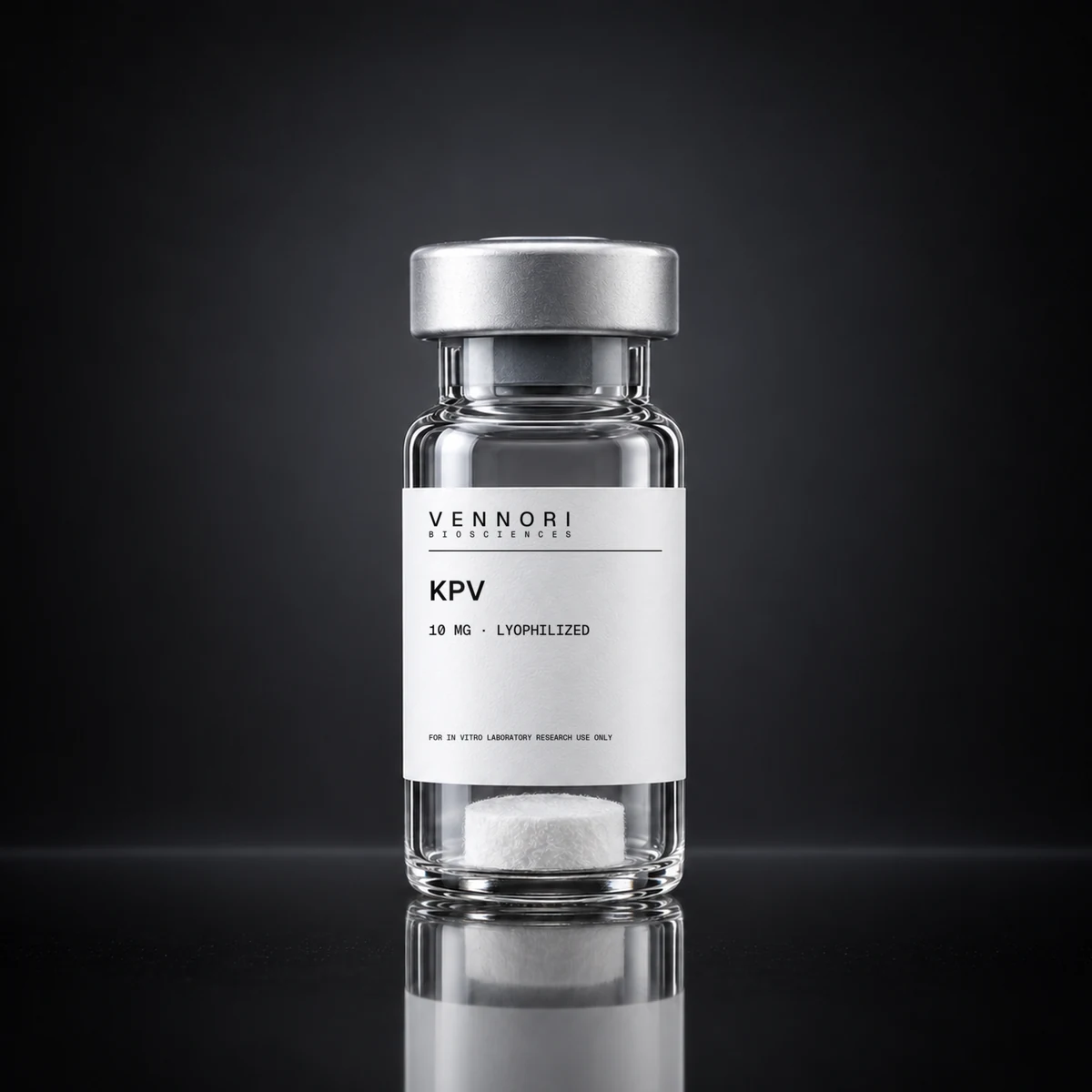
Coming soon
10mg · Single vial · Lyophilized powder
In vitro laboratory research use only · Not for human or veterinary use · Batch documented · Third-party tested · Ships from Canada
§ Verification — Batch 2026-05
Janoshik Analytical
Independent Analysis
Certificates are issued and hosted by Certivos.
§ Research
KPV is the C-terminal Lys-Pro-Val three-residue sequence (residues 11-13) of alpha-melanocyte-stimulating hormone (alpha-MSH), the 13-residue melanocortin derived from proopiomelanocortin. Early structure-activity work identified this C-terminal segment as retaining much of the anti-inflammatory and antimicrobial activity attributed to the parent molecule, while lacking the central His-Phe-Arg-Trp core responsible for melanocortin receptor-mediated pigmentary effects. Its small size, resistance to degradation, and suitability for oral and topical delivery systems have made it a reference compound in research on intestinal inflammation, epithelial barrier function, and melanocortin-related immunomodulation.
Unlike full-length alpha-MSH, KPV appears to act largely independently of high-affinity melanocortin receptor binding, although some studies report MC1R or MC3R involvement. In intestinal epithelial and immune cells, it is transported intracellularly by the proton-coupled transporter PepT1 (SLC15A1), which is upregulated in inflamed colonic tissue. Intracellularly, KPV has been associated with reduced activation of NF-kappaB and MAP kinase signaling and decreased expression of pro-inflammatory cytokines such as IL-6, IL-8, and TNF-alpha. Direct antimicrobial activity against Candida albicans and Staphylococcus aureus has also been described in vitro, an activity shared with the parent hormone.
Murine models of dextran sulfate sodium and TNBS-induced colitis characterize effects on histological inflammation and myeloperoxidase activity, dependent on PepT1 expression.
In vitro keratinocyte and bronchial epithelial cell studies describe inhibition of inflammatory signaling cascades.
Hyaluronic acid-functionalized nanoparticles and mucoadhesive hydrogel delivery systems have been developed to target KPV to inflamed colonic mucosa, with rodent models characterizing epithelial barrier and cytokine endpoints.
Controlled clinical trial data in human subjects are not available; the literature remains confined to cell culture and rodent models.
alpha-Melanocyte-stimulating hormone, MSH 11-13 KPV and adrenocorticotropic hormone signalling in human keratinocyte cells
A KPV-binding double-network hydrogel restores gut mucosal barrier in an inflamed colon
The information above is derived from published preclinical and clinical research. It is provided for educational purposes only and does not constitute medical advice, diagnosis, or treatment recommendations.