Coming soon
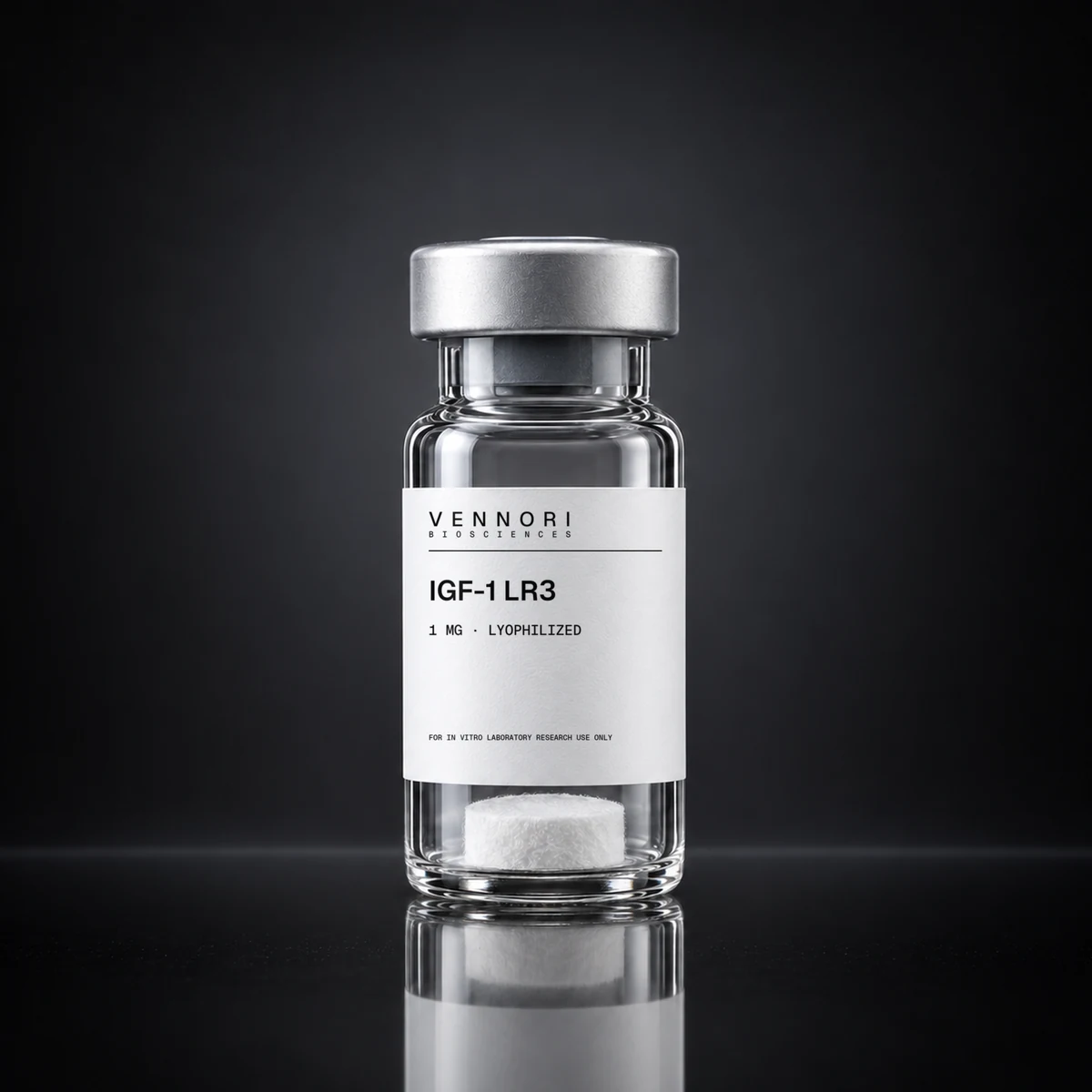
IGF-1 LR3
1mg · Single vial · Lyophilized powder
- Dose
- 1mg
- Pack size
- Single vial
- Form
- Lyophilized powder
- Storage
- 2–8°C
In vitro laboratory research use only · Not for human or veterinary use · Batch documented · Third-party tested · Ships from Canada
§ Research
Research · IGF-1 LR3
Overview
IGF-1 LR3 (Long R3 IGF-I) is an 83-amino-acid recombinant analog of human insulin-like growth factor 1. It differs from the native 70-residue sequence by substitution of arginine for glutamic acid at position 3 and by a 13-residue N-terminal extension. These modifications sharply reduce affinity for IGF-binding proteins while preserving activity at the type 1 IGF receptor. Originally developed by Australian researchers in the early 1990s, it is widely used as a cell culture supplement and as a research tool in IGF receptor pharmacology.
Mechanism of action
Activates the type 1 IGF receptor (IGF-1R), a receptor tyrosine kinase expressed in skeletal muscle, bone, liver, and many cultured cell lines. Ligand binding triggers receptor autophosphorylation and recruitment of insulin receptor substrate proteins, activating the PI3K/Akt/mTOR pathway that regulates protein synthesis and cell survival, and the Ras/MAPK pathway that regulates proliferation and differentiation. Because native IGF-1 is largely sequestered by IGF-binding proteins in serum and conditioned media, the reduced binding-protein affinity of the LR3 analog increases the free, receptor-available fraction and extends its effective activity in experimental systems.
Key research findings
- 01
Comparative in vitro studies of recombinant fusion analogs established that reduced IGF-binding protein affinity, rather than altered receptor affinity, accounts for the enhanced biological potency of the Long R3 variant.
- 02
Preclinical rodent studies characterized anabolic endpoints, including nitrogen balance and organ growth, in dexamethasone-treated models, with IGF-1 variants producing larger responses than native IGF-1.
- 03
Myoblast culture studies use the analog to characterize IGF-driven proliferation and differentiation in the presence and absence of exogenous binding proteins.
- 04
Infusion studies in pigs and guinea pigs documented reduced endogenous IGF-1, IGFBP-3, and growth hormone concentrations, consistent with feedback suppression of the somatotropic axis.
Published references
Novel recombinant fusion protein analogues of insulin-like growth factor (IGF)-I indicate the relative importance of IGF-binding protein and receptor binding for enhanced biological potency
Insulin-like growth factor-I (IGF-I) and especially IGF-I variants are anabolic in dexamethasone-treated rats
The information above is derived from published preclinical and clinical research. It is provided for educational purposes only and does not constitute medical advice, diagnosis, or treatment recommendations.