Coming soon
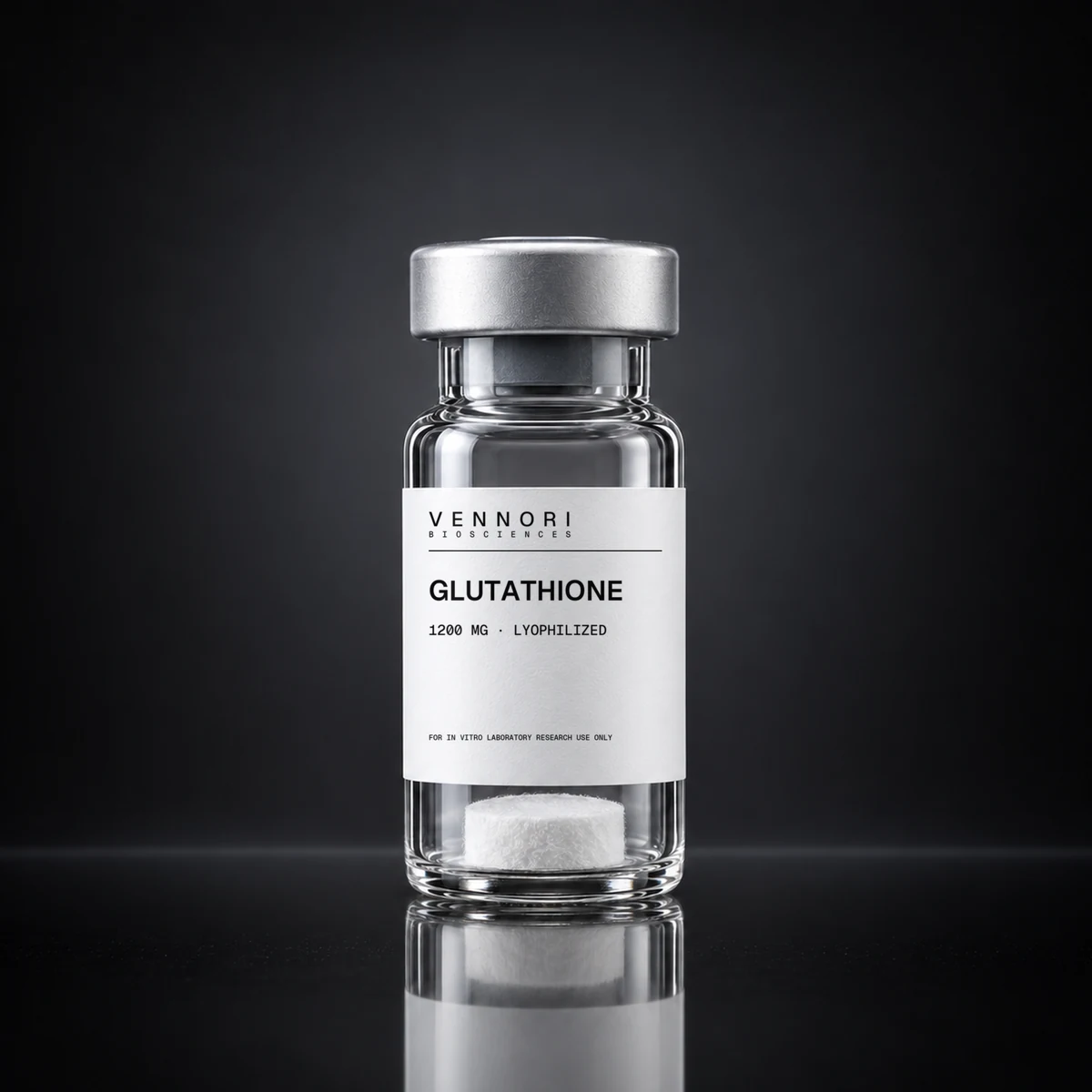
Glutathione
1200mg · Single vial · Lyophilized powder
- Dose
- 1200mg
- Pack size
- Single vial
- Form
- Lyophilized powder
- Storage
- 2–8°C
In vitro laboratory research use only · Not for human or veterinary use · Batch documented · Third-party tested · Ships from Canada
§ Research
Research · Glutathione
Overview
Glutathione is the Glu-Cys-Gly thiol, an endogenous low-molecular-weight compound present at millimolar concentrations in most mammalian cells. Its glutamate residue is linked through an unusual gamma-carboxyl bond, conferring resistance to typical protease cleavage. It exists in reduced (GSH) and oxidized disulfide (GSSG) forms, and the GSH/GSSG ratio is widely used as a reference index of cellular redox state in laboratory research. It is supplied as a laboratory reagent for redox biochemistry, enzyme assays, and cell culture studies of oxidative stress.
Mechanism of action
Glutathione is synthesized in the cytosol by two ATP-dependent steps: glutamate-cysteine ligase forms gamma-glutamylcysteine, the rate-limiting step governed by cysteine availability and feedback inhibition, and glutathione synthetase adds glycine. The cysteine thiol donates reducing equivalents to glutathione peroxidases that reduce hydrogen peroxide and lipid hydroperoxides, and glutathione reductase regenerates GSH from GSSG using NADPH. Glutathione S-transferases conjugate it to electrophilic xenobiotics, and it participates in protein S-glutathionylation, nitric oxide transport, and ferroptosis regulation through GPX4. Extracellular glutathione is broken down by membrane gamma-glutamyl transferase, and the resulting amino acids are taken up for intracellular resynthesis.
Key research findings
- 01
Biochemical studies have characterized the regulation of glutamate-cysteine ligase by its catalytic and modifier components and by Nrf2-dependent transcription.
- 02
Nutritional and metabolic research has characterized the dependence of tissue glutathione on dietary sulfur amino acid supply, particularly cysteine.
- 03
Cell and rodent models have established glutathione depletion as a standard experimental condition for studying oxidative stress and ferroptosis.
- 04
Clinical pharmacokinetic studies have characterized limited systemic availability of intact exogenous glutathione owing to rapid extracellular breakdown by gamma-glutamyl transferase.
Published references
Glutathione synthesis
Glutathione metabolism and its implications for health
The information above is derived from published preclinical and clinical research. It is provided for educational purposes only and does not constitute medical advice, diagnosis, or treatment recommendations.