Coming soon
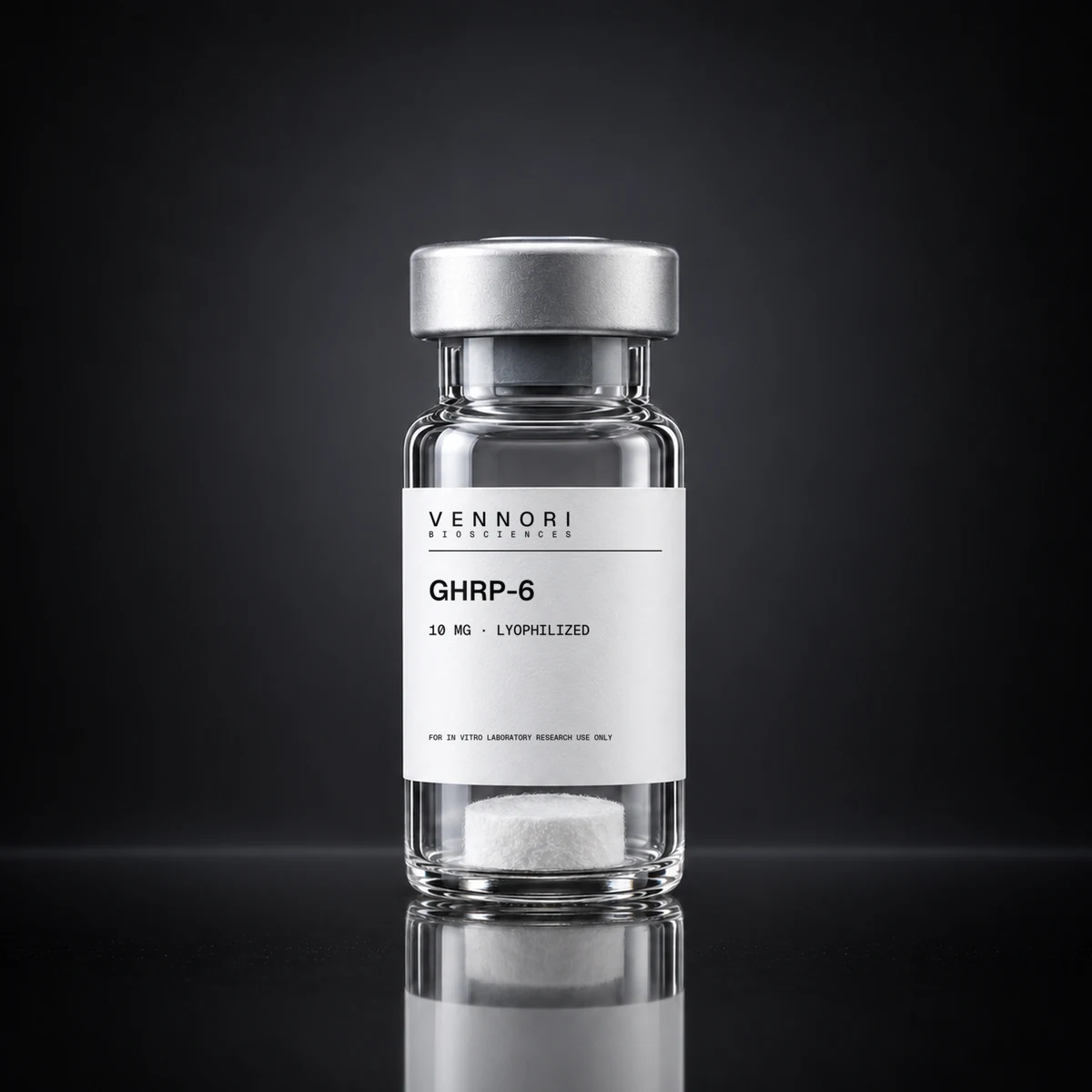
GHRP-6
10mg · Single vial · Lyophilized powder
- Dose
- 10mg
- Pack size
- Single vial
- Form
- Lyophilized powder
- Storage
- 2–8°C
In vitro laboratory research use only · Not for human or veterinary use · Batch documented · Third-party tested · Ships from Canada
§ Research
Research · GHRP-6
Overview
GHRP-6 (His-D-Trp-Ala-Trp-D-Phe-Lys-NH2) is a synthetic six-residue growth hormone secretagogue first described by Cyril Bowers and colleagues in the early 1980s, derived from structural modification of met-enkephalin analogs. It was the first compound in its series with robust in vivo growth hormone-releasing activity, and it was used as the ligand that led to cloning of the ghrelin receptor before ghrelin itself was identified. GHRP-6 remains a widely used reference agonist in ghrelin receptor pharmacology.
Mechanism of action
Activates the growth hormone secretagogue receptor type 1a (GHS-R1a), a Gq/11-coupled G-protein-coupled receptor expressed in the pituitary, hypothalamic arcuate nucleus, and peripheral tissues including the heart. Receptor stimulation activates phospholipase C, generating inositol trisphosphate and mobilizing intracellular calcium to drive growth hormone exocytosis. Hypothalamic actions include activation of GHRH neurons and functional antagonism of somatostatin, accounting for its synergy with GHRH. GHRP-6 also stimulates appetite-regulating circuits and binds the scavenger receptor CD36, which is implicated in some of its reported cardiovascular effects. Its appetite-related activity is more pronounced than that of later, more selective agonists such as ipamorelin.
Key research findings
- 01
Expression cloning studies used GHRP-class ligands to identify the pituitary and hypothalamic receptor mediating secretagogue-induced growth hormone release, later shown to be the ghrelin receptor.
- 02
Clinical studies in subjects with hypothalamopituitary disconnection showed blunted responses, supporting a predominant hypothalamic site of action.
- 03
Preclinical rodent studies characterized effects on food intake, bone mineral content, and cardiac function, reviewed alongside other secretagogues across organ systems.
- 04
Animal models of doxorubicin cardiotoxicity and myocardial infarction characterized cytoprotective endpoints associated with activation of prosurvival signaling.
Published references
A receptor in pituitary and hypothalamus that functions in growth hormone release
Clinical and experimental effects of growth hormone secretagogues on various organ systems
The information above is derived from published preclinical and clinical research. It is provided for educational purposes only and does not constitute medical advice, diagnosis, or treatment recommendations.