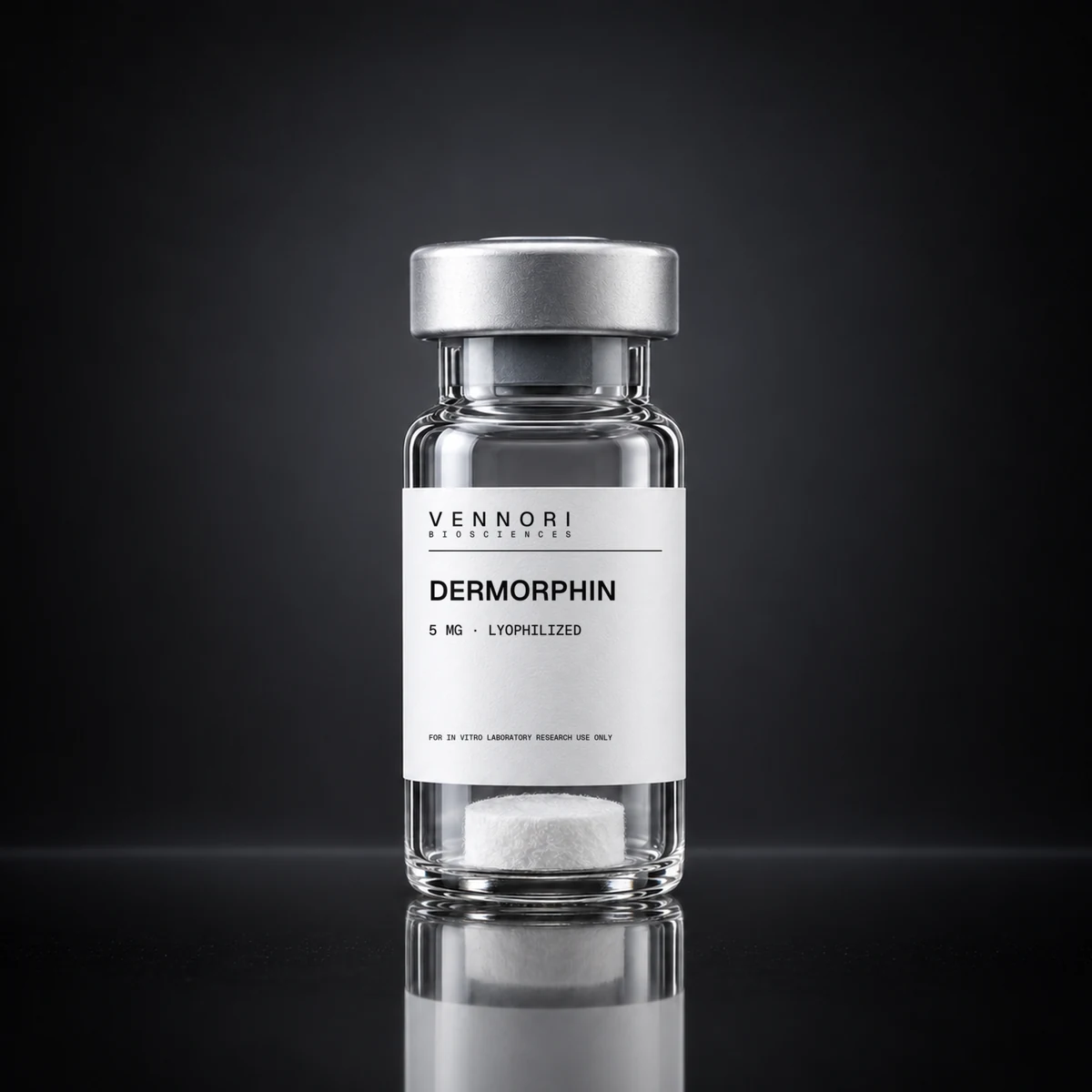
Coming soon
Dermorphin
5mg · Single vial · Lyophilized powder
- Dose
- 5mg
- Pack size
- Single vial
- Form
- Lyophilized powder
- Storage
- 2–8°C
In vitro laboratory research use only · Not for human or veterinary use · Batch documented · Third-party tested · Ships from Canada
§ Research
Research · Dermorphin
Overview
Dermorphin is a seven-residue opioid sequence, Tyr-D-Ala-Phe-Gly-Tyr-Pro-Ser-NH2, first isolated in 1981 by Erspamer, Montecucchi, and colleagues from the skin of South American Phyllomedusa frogs. It contains a D-alanine at position 2, an unusual post-translational feature in animal-derived sequences, which confers resistance to proteolytic degradation. It is studied as a reference compound in mu-opioid receptor pharmacology and analgesia research. Its discovery provided early evidence that D-amino acids occur naturally in animal-derived sequences through post-translational isomerization, and it has served as a template for numerous synthetic analogs with modified potency and stability.
Mechanism of action
Acts as a highly selective and potent agonist at the mu-opioid receptor, a G-protein-coupled receptor expressed throughout the central and peripheral nervous systems. Receptor activation inhibits adenylyl cyclase, opens inwardly rectifying potassium channels, and reduces voltage-gated calcium currents, suppressing nociceptive transmission. The D-alanine residue and C-terminal amide stabilize the molecule against enzymatic cleavage, and the N-terminal Tyr-D-Ala-Phe motif is the minimal pharmacophore for receptor binding. Its relative potency exceeds that of morphine in rodent central administration assays. Analogs incorporating modified N-terminal residues have been used to probe mu-opioid receptor subtypes and the relationship between peripheral and central antinociceptive actions.
Key research findings
- 01
Structure-activity studies identify the N-terminal four residues as the core pharmacophore and characterize numerous synthetic analogs with altered potency and stability.
- 02
Rodent studies characterize antinociceptive potency greater than morphine following central administration, with distinct tolerance profiles.
- 03
Equine pharmacokinetic and pharmacodynamic studies have characterized plasma disposition and locomotor effects, informing veterinary anti-doping detection.
- 04
Early clinical investigations characterized analgesic endpoints in postoperative and palliative settings before development was discontinued.
Published references
Pharmacokinetics and pharmacodynamics of dermorphin in the horse
Rediscovery of old drugs: the forgotten case of dermorphin for postoperative pain and palliation
The information above is derived from published preclinical and clinical research. It is provided for educational purposes only and does not constitute medical advice, diagnosis, or treatment recommendations.