Certivos verified
Analycor Laboratories
Independent Analysis
- Purity
- 99.8%
- Method
- HPLC + LC-MS
- Test date
- 2026-10-08
KEX8UYY65XAT→ View certificate
This site supplies research compounds and laboratory materials for in vitro research only. Not for human or veterinary use.
I confirm I am 21 years of age or older and that any purchase is for laboratory research use only.
UP TO 30% OFF Retatrutide · Semaglutide · Tirzepatide — Limited TimeShop now
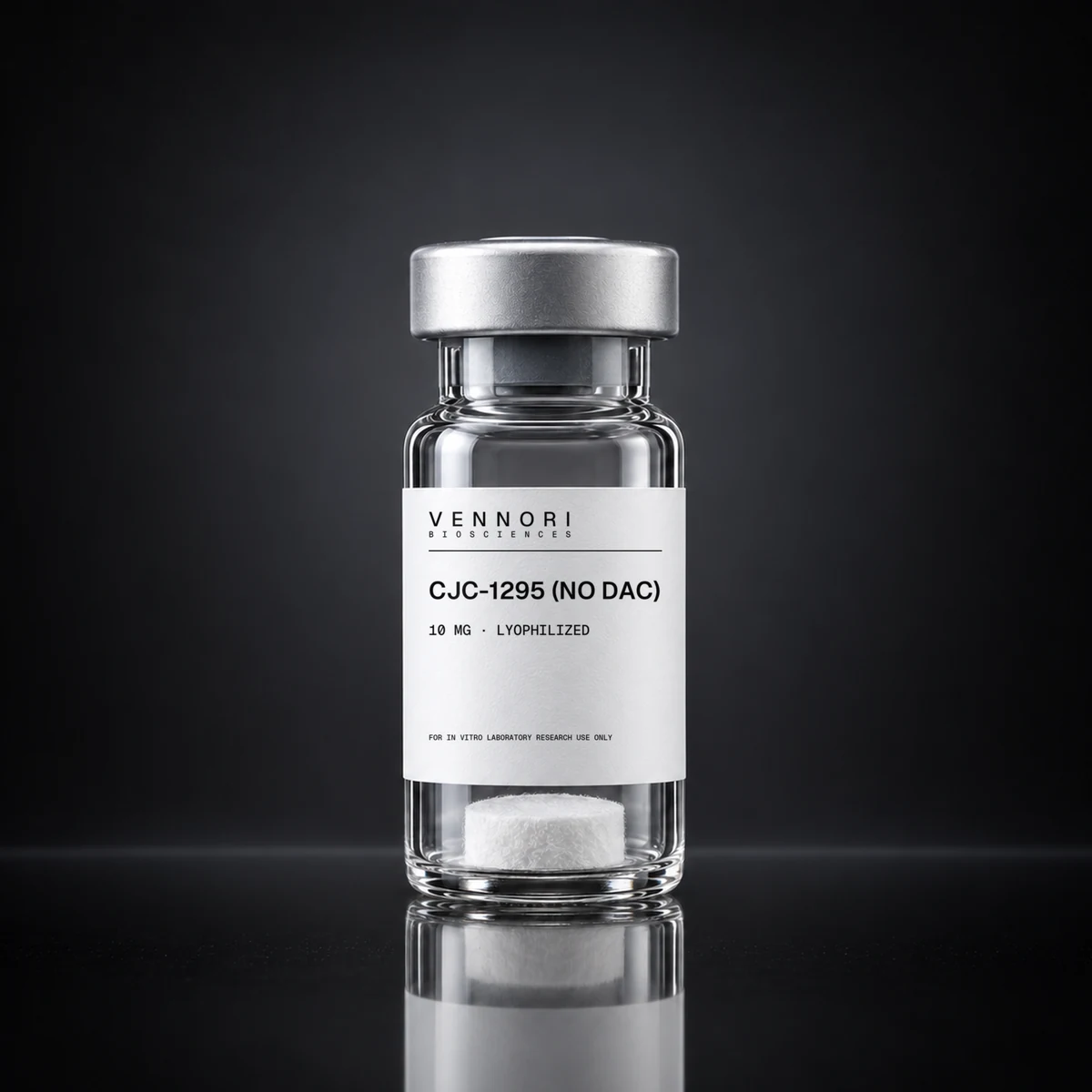
In stock
10mg · Single vial · Lyophilized powder
Order
No crypto required. Pay with Visa, Mastercard, Amex, Apple Pay, Google Pay, or Interac.






In vitro laboratory research use only · Not for human or veterinary use · Batch documented · Third-party tested · Ships from Canada
§ Verification — Batch 202611-01-CND
Analycor Laboratories
Independent Analysis
Certificates are issued and hosted by Certivos.
§ Research
CJC-1295 (No DAC), also known as modified GRF (1-29), is a synthetic 29-residue analog of the biologically active N-terminal fragment of growth hormone-releasing hormone. It carries four amino acid substitutions (D-Ala2, Gln8, Ala15, Leu27) that stabilize the sequence against enzymatic degradation and chemical rearrangement, but lacks the maleimido-lysine albumin-binding moiety of the DAC form. Its circulating half-life is therefore short, measured in minutes, and it is used in research on pulsatile GHRH receptor stimulation and on the structural determinants of GHRH analog stability.
Acts as an agonist at the GHRH receptor, a class B G-protein-coupled receptor on anterior pituitary somatotrophs. Binding activates Gs-coupled adenylyl cyclase, raising cAMP and activating protein kinase A and CREB-dependent transcription of the growth hormone gene, together with calcium influx that triggers hormone release. The D-Ala2 substitution impairs DPP-4 cleavage at the N-terminus, Gln8 prevents asparagine deamidation, Ala15 improves receptor binding stability, and Leu27 removes an oxidation-prone methionine. Without albumin conjugation, the analog produces a discrete growth hormone pulse that remains subject to somatostatin inhibition and IGF-1 feedback.
Human pharmacokinetic studies demonstrated that incorporating D-Ala2 into GHRH (1-29) increases half-life and decreases metabolic clearance relative to the native fragment.
Structure-activity studies of GRF analogs established that substitutions at positions 8, 15, and 27 enhance stability and receptor activity in rat pituitary assays.
The tetrasubstituted sequence served as the parent analog in rat studies that developed the albumin-conjugated CJC-1295 (DAC), providing a direct short-acting comparator.
Anti-doping analytical studies have characterized detection of modified GRF (1-29) and related GHRH analogs and their metabolites in urine.
Incorporation of D-Ala2 in growth hormone-releasing hormone-(1-29)-NH2 increases the half-life and decreases metabolic clearance in normal men
Human growth hormone-releasing factor (hGRF)1-29-albumin bioconjugates activate the GRF receptor on the anterior pituitary in rats: identification of CJC-1295 as a long-lasting GRF analog
The information above is derived from published preclinical and clinical research. It is provided for educational purposes only and does not constitute medical advice, diagnosis, or treatment recommendations.