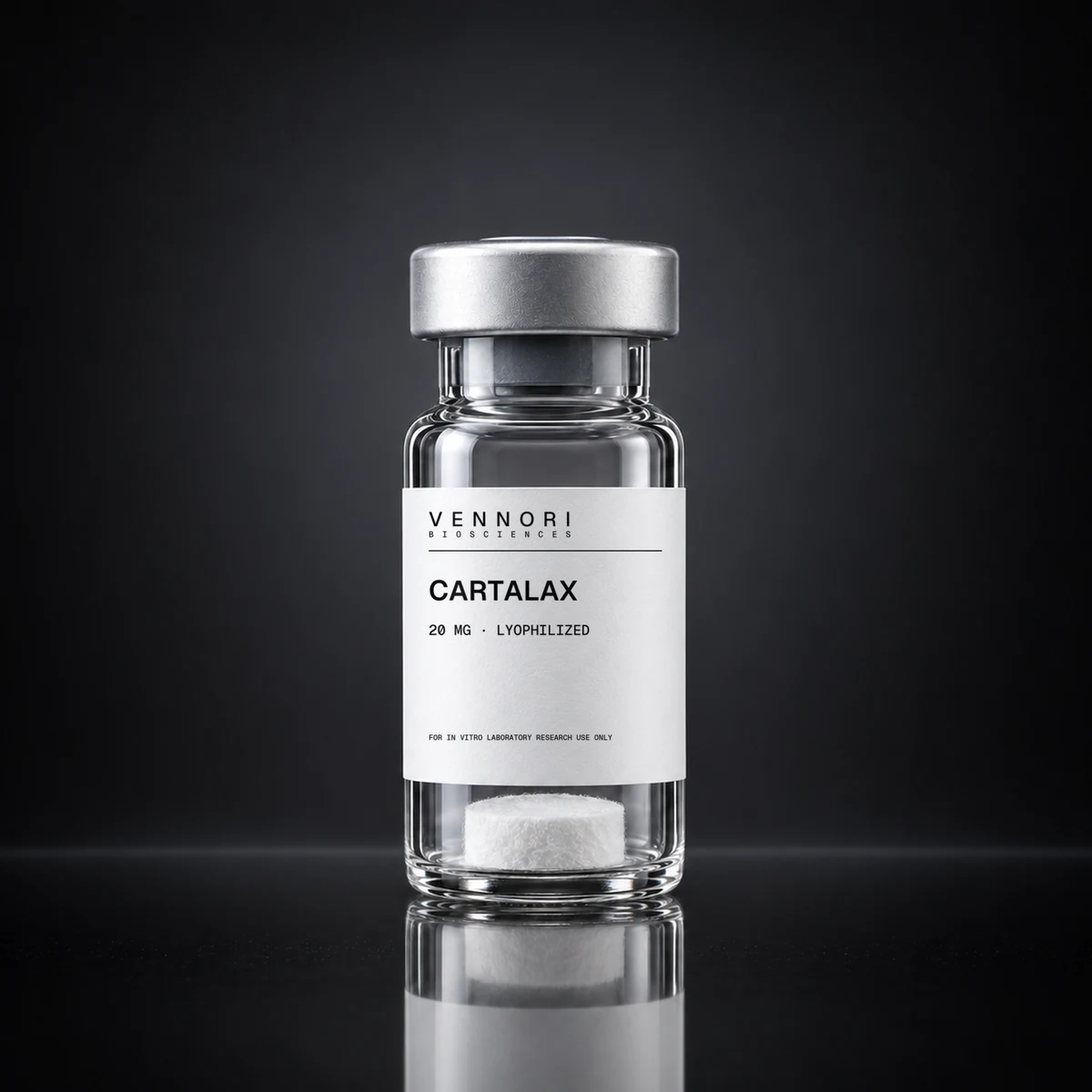
Coming soon
Cartalax
20mg · Single vial · Lyophilized powder
- Dose
- 20mg
- Pack size
- Single vial
- Form
- Lyophilized powder
- Storage
- 2–8°C
In vitro laboratory research use only · Not for human or veterinary use · Batch documented · Third-party tested · Ships from Canada
§ Research
Research · Cartalax
Overview
Cartalax is a synthetic three-residue sequence (Ala-Glu-Asp, designated AED) described by Khavinson's group as a cartilage-associated bioregulator. It was developed as a defined synthetic counterpart to a cartilage-derived low-molecular-weight extract and is studied in models of chondrocyte, fibroblast, and mesenchymal stem cell aging. Available research comes almost entirely from the originating institute in St. Petersburg. Published reports are predominantly in vitro and use comparative designs against the parent tissue extract or against other short sequences in the same series. Independent replication outside the originating research network has not been reported in indexed literature.
Mechanism of action
The proposed mechanism follows the group's general short bioregulator model, in which the sequence is reported to reach the nucleus and modulate transcription of tissue-specific genes through interaction with DNA and chromatin. In chondrocyte cultures it is reported to normalize markers of the senescence-associated secretory phenotype, including p16, p21, and p53, and the pro-inflammatory cytokines TNF-alpha and IL-1-alpha, while restoring Sirt1 synthesis. In dermal fibroblasts it is reported to increase sirtuin-1, sirtuin-6, and collagen I synthesis during replicative aging. These activities are described as tissue-specific, with the group proposing that each short sequence in the series preferentially acts on the tissue from which its parent extract was derived.
Key research findings
- 01
Chondrocyte culture studies compared AED with a cartilage-derived extract and reported normalization of senescence-associated secretory markers and Sirt1 synthesis.
- 02
Human skin fibroblast studies during replicative aging characterized increased sirtuin-1, sirtuin-6, and collagen I synthesis by immunocytochemistry and confocal microscopy.
- 03
Studies from the same research network examined AED alongside related short sequences in human mesenchymal stem cell cultures during replicative aging, including chondrogenic differentiation.
- 04
Primary research is published in Russian-language journals and remains uncharacterized in Western clinical databases.
The information above is derived from published preclinical and clinical research. It is provided for educational purposes only and does not constitute medical advice, diagnosis, or treatment recommendations.