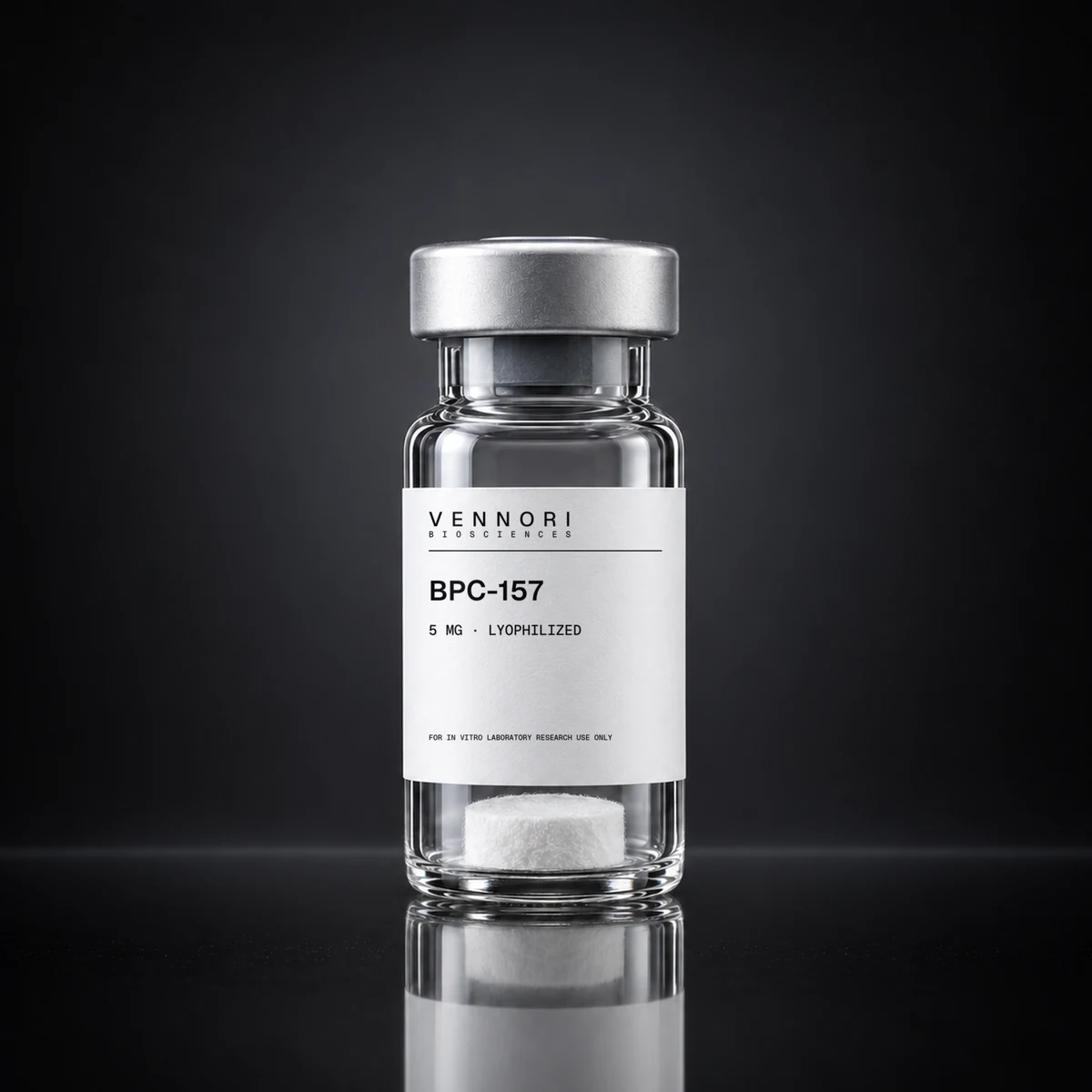
Coming soon
BPC-157
5mg · Single vial · Lyophilized powder
- Dose
- 5mg
- Pack size
- Single vial
- Form
- Lyophilized powder
- Storage
- 2–8°C
In vitro laboratory research use only · Not for human or veterinary use · Batch documented · Third-party tested · Ships from Canada
§ Research
Research · BPC-157
Overview
BPC-157 is a synthetic 15-residue sequence (Gly-Glu-Pro-Pro-Pro-Gly-Lys-Pro-Ala-Asp-Asp-Ala-Gly-Leu-Val) corresponding to a partial fragment of a larger protein originally described in human gastric juice and termed "body protection compound." It is notable among short synthetic sequences for its reported stability in gastric juice. Most of its literature originates from a single research group in Zagreb, and it is primarily used as a research compound in rodent models of gastrointestinal, vascular, and musculoskeletal tissue injury. It has no regulatory approval in any jurisdiction.
Mechanism of action
No single high-affinity receptor has been identified; proposed mechanisms are pleiotropic. Preclinical work reports modulation of the nitric oxide system, with effects that interact with both L-NAME and L-arginine challenge. In cultured endothelial cells and tendon fibroblasts, the compound has been associated with increased VEGFR2 expression and downstream Akt-eNOS signaling, activation of the FAK-paxillin pathway governing cell spreading and migration, and upregulation of growth hormone receptor expression. Early growth response gene 1 (EGR-1) induction has also been reported as an upstream event in angiogenic signaling.
Key research findings
- 01
Preclinical rodent studies characterize effects on tendon, ligament, muscle, and bone repair endpoints, including transected Achilles tendon and quadriceps models.
- 02
Rodent models of gastrointestinal lesions, fistulas, and anastomoses have characterized the compound's effects on mucosal integrity and vascular responses.
- 03
In vitro and in vivo vascular studies describe interactions with angiogenic growth factor signaling and the NO system, summarized in a 2014 review on BPC 157 and blood vessels.
- 04
A 2025 systematic review identified only small, uncontrolled human reports; controlled clinical trial data remain absent, and the compound appears on the World Anti-Doping Agency prohibited list.
Published references
BPC 157 and blood vessels
BPC 157 and Standard Angiogenic Growth Factors. Gastrointestinal Tract Healing, Lessons from Tendon, Ligament, Muscle and Bone Healing
Emerging Use of BPC-157 in Orthopaedic Sports Medicine: A Systematic Review
The information above is derived from published preclinical and clinical research. It is provided for educational purposes only and does not constitute medical advice, diagnosis, or treatment recommendations.